Full Guide to Getting Apostilles for International Use
If you need to use a document issued outside the United States in a different foreign country, and you’re currently in California, we can help.
Whether you’re dealing with Mexican birth certificates, European diplomas, South American marriage certificates, or Middle Eastern court documents, this page will walk you through the entire apostille process in California for foreign-issued documents—from requirements to turnaround times.
What Is an Apostille?
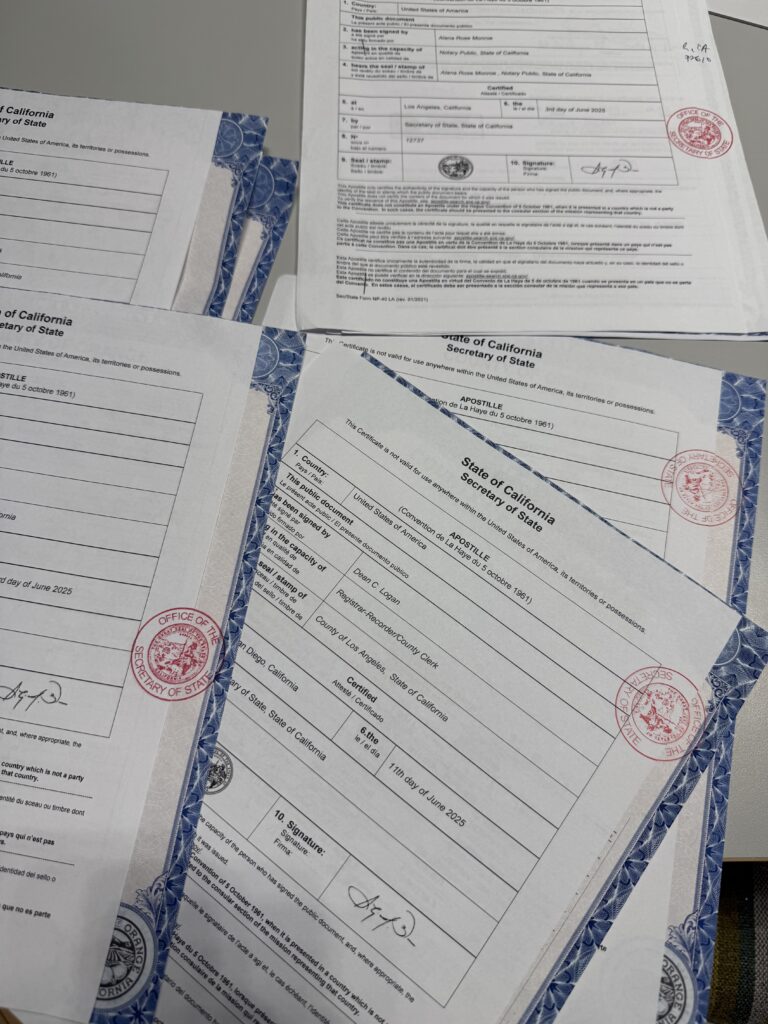
An apostille is a form of authentication issued to documents for use in countries that are members of the Hague Apostille Convention of 1961. It certifies the origin and authenticity of public documents such as birth certificates, marriage certificates, powers of attorney, court rulings, notarized statements, and more.
If your destination country is not a member of the Hague Convention, the document must go through consular legalization, which is a different process.
Can You Apostille Foreign Documents in California?
Yes—but with limitations.
California can only issue apostilles for documents that have been notarized or certified in California.
Here’s How it Works
Translate the Foreign Document into English (or into the destination country’s language)
• Use a certified translator who provides a declaration of accuracy. • Some countries require the translation to be into their local language (e.g., Spanish, French, German).
Certify the Document Through Notarization
Notarize the foreign document by certifying the document by notarizing a copy of the document
Apostille/Authentication
After the notarization is complete, apostille the notarized copy of the document.
Which Countries Accept Apostilles?
You can only use the apostille method if the destination country is part of the Hague Convention. Some examples include:
🇲🇽 Mexico
🇪🇸 Spain
🇫🇷 France
🇩🇪 Germany
🇨🇱 Chile
🇮🇹 Italy
🇯🇵 Japan
🇰🇷 South Korea
🇵🇭 Philippines
If your country is not a member (e.g., UAE, China, Qatar, Egypt, etc.), you will need consular legalization instead. We can assist with this as well.
Common Scenarios We Help With
Dual citizenship applications (e.g., Mexican-American, Italian-American)
Marriage abroad (e.g., apostilling foreign birth or divorce records)
International property transfers
Study or work visa applications
Immigration proceedings
Court use in another country
Reclaiming foreign inheritance
FAQs
If you notarize and apostille a copy of a mexican birth certificate in california, will spain accept it?
Yes, Spain will generally accept a notarized and apostilled copy of a Mexican birth certificate from California, as long as the notarization is done properly and the document is translated into Spanish by a certified translator.
Here’s how to make it acceptable for Spanish authorities (e.g., Registro Civil, extranjería, consulate, etc.):
✅ Correct Process for Spain to Accept a Mexican Birth Certificate Apostilled in California:
Certified Translation into Spanish
The Mexican birth certificate must be translated into Spanish by a certified translator. Spain often prefers or requires sworn (traductor jurado) translators, but for most purposes, a certified translator in California with a signed declaration is acceptable.
If you’re submitting the document to the Consulate of Spain in Los Angeles, they will usually accept a certified translation done locally in California.
Notarized Translator’s Declaration
The translator must provide a signed declaration of accuracy, which is then notarized by a California notary public.
Apostille the Notarized Declaration
You submit the notarized translator’s declaration (with the attached copy of the birth certificate) to the California Secretary of State to obtain the apostille.
Submit the Apostilled Document to Spanish Authorities
The final packet (apostille + notarized translation + copy of original) is usually accepted by immigration offices, civil registries, consulates, or universities in Spain.
⚠️ Important Notes:
Spain does not accept apostilles issued directly on a foreign birth certificate unless it comes from the issuing country’s authority (i.e., Mexico).
A copy of the Mexican birth certificate by itself cannot be apostilled unless accompanied by a notarized translator declaration or affidavit.
If you need to use the original Mexican birth certificate in Spain, the best way is to apostille it in Mexico through the Secretaría de Gobernación or corresponding State Government, then translate it in Spain using a Spanish sworn translator.
✅ Summary:
Yes, Spain will accept a California-apostilled copy of a Mexican birth certificate—if it’s translated to Spanish, notarized properly in California, and apostilled by the California Secretary of State.
This is a common method used by applicants for Spanish citizenship, residency, marriage registration, or immigration documentation who are located in the United States and cannot travel to Mexico to obtain an apostille there.
1.
Q: If I notarize and apostille a copy of an Italian university degree in California, will it be accepted in Germany?
A: Germany typically does not accept notarized copies of foreign academic documents that were apostilled in the United States. To use an Italian degree in Germany, it is best to obtain an original or certified copy from the Italian university, then have it apostilled in Italy. If you’re located in California, you may instead translate the degree to German, notarize the translator’s declaration, and apostille that. However, this is often only acceptable for informational or informal purposes, not for university enrollment or professional licensing. For official use in Germany, use original documents apostilled in the issuing country, and have the translation done by a German-certified translator.
2.
Q: Can I apostille a notarized copy of a Colombian marriage certificate in California for use in Canada?
A: No. Apostilles are not recognized by Canada, because Canada is not a member of the Hague Apostille Convention. Instead, Canada requires authentication and legalization. If you notarize a translator’s declaration for the Colombian marriage certificate in California, you can authenticate it through the California Secretary of State, and then have it legalized by the Canadian consulate. This is a multi-step process and not the same as apostille. Our team offers authentication + consular legalization services for Canadian use.
3.
Q: Will the Philippines accept a notarized and apostilled copy of a U.S. death certificate for estate proceedings?
A: Yes, the Philippines is a member of the Hague Apostille Convention and generally accepts apostilled documents from the U.S. However, the U.S. death certificate must be an official certified copy issued by the vital records office (e.g., California Department of Public Health or County Clerk). You can then apostille the original document directly—no notarization required unless it’s a non-vital record. If the document is in English and going to a Filipino court or notary, a certified Filipino/Tagalog translation may also be required depending on the location and use case.
4.
Q: I have a power of attorney from Mexico. Can I apostille it in California for use in Spain?
A: No, you cannot apostille a Mexican power of attorney in California, even if you’re physically located in California. Documents must be apostilled by the country where they were originally issued. In this case, the power of attorney must be apostilled in Mexico, through the relevant state-level Secretaría General de Gobierno. However, if you create a new power of attorney in California (written in Spanish, notarized, and apostilled), Spain will accept it—especially if it’s for use by a Spanish notary or property transaction. Spain does accept U.S. notarized powers of attorney if translated and apostilled properly.
5.
Q: Can I notarize and apostille a copy of my Russian divorce decree in California to use for remarriage in the U.S.?
A: Yes—if the Russian divorce decree is translated into English, and the translator provides a notarized declaration, California can issue an apostille on that notarized declaration. This process is often used for foreign divorce decrees in immigration, marriage license applications, or legal status changes. While the apostille authenticates the signature of the notary, U.S. agencies will rely on the accuracy of the translation and may also require the original Russian divorce decree for reference.
6.
Q: Can I apostille a notarized copy of my Brazilian university diploma in California for use in Portugal?
A: Not directly. Portugal generally requires original Brazilian diplomas to be apostilled in Brazil. However, if you’re in California and cannot get a Brazilian apostille, you can translate the diploma into Portuguese, have the translator sign a sworn statement, notarize it in California, and apostille the translator’s declaration. This is a common workaround used in immigration or job applications, but Portuguese authorities (such as SEF or universities) may still request the original diploma apostilled in Brazil. Check with your end institution for their specific requirements.
7.
Q: Will a California apostille on a notarized translation of a Guatemalan birth certificate be accepted by Italian citizenship authorities?
A: Generally yes, if the translation is into Italian and includes a California notary’s seal and signature, apostilled by the California Secretary of State. Many Italian consulates and citizenship offices accept this method if the applicant is located abroad. However, Italy strongly prefers the original birth certificate be apostilled in Guatemala by the Ministerio de Relaciones Exteriores. If that’s not possible, a notarized and apostilled translation from California can work temporarily or in support of a full application.
8.
Q: Can I apostille a California notary affidavit of authenticity attached to an old Korean high school diploma for use in Australia?
A: Yes, Australia is part of the Hague Apostille Convention and will accept California-issued apostilles if the notarization is properly done. In this case, the Korean diploma can be attached to a sworn affidavit of authenticity (stating it’s a true copy), notarized by a California notary, and then submitted for apostille. If Australia requires the diploma to be in English, you’ll also need a certified English translation, which should be notarized and apostilled as well. This process is often used for academic admissions, immigration, or employment verification.
Apostilling a California Degree for Australian Skilled Migration: A Lake Forest Case Study
How a Lake Forest project manager apostilled his California degree for Australian skilled migration via mail-in service — and what the process actually requires.
Apostilling a Transcript for University Admission in South Korea: A Fullerton Student’s Case Study
A Fullerton student’s real path to apostille her transcript for a Seoul graduate program — what counts as apostillable, and how translation fits in.
Apostilling a Diploma to Teach at a University in Japan: An Irvine PhD’s Case Study
How an Irvine PhD apostilled his diploma for a Japanese university lecturer position: notarization, Hague apostille, and certified translation explained.
Apostille for a Single-Status Affidavit in Greece: A Newport Beach Couple’s Santorini Wedding Case Study
How a Newport Beach couple apostilled a single-status affidavit and translated it for their Santorini wedding — the exact notarize-apostille-translate sequence explained.
Apostilling a Divorce Decree for a Remarriage in the Philippines: A Cypress Case Study
How a Cypress resident apostilled a California divorce decree for a Manila remarriage, since the Philippines now uses apostilles, not red-ribbon legalization.
Apostilling a Death Certificate for a German Pension Claim: A Mission Viejo Case Study
How a Mission Viejo widow apostilled a California death certificate with certified German translation to claim her late husband’s Deutsche Rentenversicherung pension.